
HVAC for Modular Buildings
Real Buildings. Real Mechanical Standards.
Modular buildings are a permanent and growing part of Houston’s commercial landscape, from job site trailers on active construction projects to permanent modular classrooms, medical facilities, and industrial offices. These structures have real operational needs and present real HVAC challenges that are distinct from conventional construction. Getting heating and cooling right here requires understanding how these buildings are built, how they’re used, and what Houston’s climate demands of any mechanical system operating in them.
The Challenge
The Same Climate. A Much Harder Building to Condition.
Modular buildings are constructed off-site and delivered as completed units, which means the mechanical systems serving them must accommodate structures that weren’t designed with site-specific conditions in mind.
Thinner Walls
Wall assemblies have less thermal mass and insulation capacity than conventional construction, making heat gain through the roof, walls, and underfloor significantly higher relative to square footage.
Limited Duct Routing
Floor and ceiling cavities are shallower, constraining duct routing options and requiring more careful mechanical design to achieve adequate airflow distribution.
Flexibility Required
Modular units are frequently reconfigured, expanded, or relocated. The HVAC systems serving them need to be flexible enough to accommodate change without requiring a full mechanical redesign.
Applications
Each Type Has Its Own Demands
We work across the full range of modular building types in the Houston market. Each presents a distinct set of mechanical challenges.
Job Site Trailers
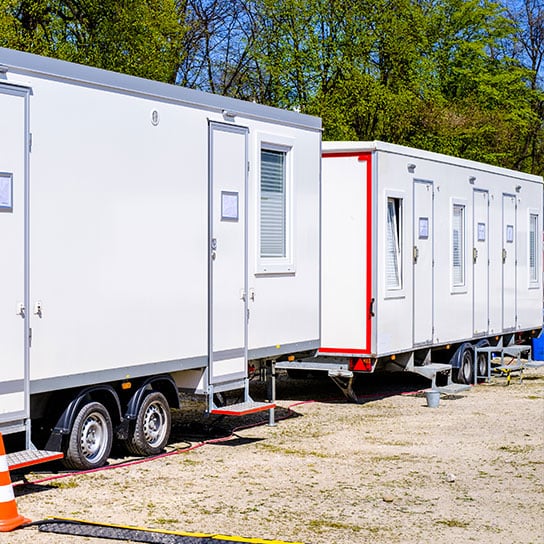
High occupancy, frequent door openings, and full solar exposure with minimal shading. Maintenance is frequently deferred because the structure is considered temporary — a false economy that often results in emergency replacement at premium cost mid-project.
Permanent Modular Commercial
Offices, retail spaces, and administrative facilities that deserve the same mechanical rigor as any conventionally constructed building. Generic equipment specification at the outset creates comfort and energy problems that persist for the building’s entire service life.
Modular Classrooms
High occupancy density, stringent ventilation requirements, and children who are particularly sensitive to carbon dioxide buildup. Humidity control in Houston’s climate is not optional here.
Medical and Industrial Facilities
The highest performance requirements of any modular building type. Medical environments have strict temperature and humidity tolerances. Industrial modular offices on Houston’s petrochemical sites must contend with extreme ambient conditions and around-the-clock occupancy.
How We Work
We Treat Modular Buildings Like the Real Buildings They Are
We bring the same diagnostic discipline to modular HVAC work that we apply to conventional commercial buildings. For existing modular buildings that aren’t performing, we assess the system as it is, identify what’s actually causing the problem, and recommend solutions that address the root cause. For new installations or replacements, we specify equipment sized for the actual load, designed around the constraints of the modular envelope, with humidity control appropriate to Houston’s climate.
The Bottom Line
Modular Doesn’t Mean Makeshift
A modular building with properly specified, correctly installed, and well-maintained HVAC performs as well as any conventionally constructed facility. The difference is in how seriously the mechanical work is taken from the start. We take it seriously.

I’ve worked with Jim for three years now. I can always count on him to give prompt service and excellent customer service!
Pac Van
Commercial Client