
Commercial HVAC Maintenance
Your System Doesn’t Get a Break. Neither Should Your Maintenance Program.
In Houston’s climate, a reactive approach to commercial HVAC maintenance is one of the most expensive ways to manage one of your largest capital assets. The system affects everything: the comfort and productivity of your employees, the experience of your customers, the integrity of your building, and the efficiency of your operating budget. Preventive maintenance is the professional standard for a reason.
The Risk
The Cost Doesn’t Disappear. It Accumulates.
Skipping preventive maintenance rarely shows up as a single line item, the damage spreads across multiple budgets over time.
Energy
Dirty coils and clogged filters force equipment to work harder than it was designed to. The efficiency penalty shows up in your utility bill every month, compounding quietly until someone notices.
Equipment Life
Components running outside their design parameters wear out faster. The equipment you’re deferring maintenance on is shortening its own service life, and its replacement will arrive on the system’s schedule, not yours.
Liability
A system failure that results in uncomfortable or unusable space, or a mold or air quality event traceable to deferred maintenance, creates exposure that far exceeds the cost of the service visits that would have prevented it.
Our Process
More Complex Equipment. Higher Stakes. More Thorough Service.
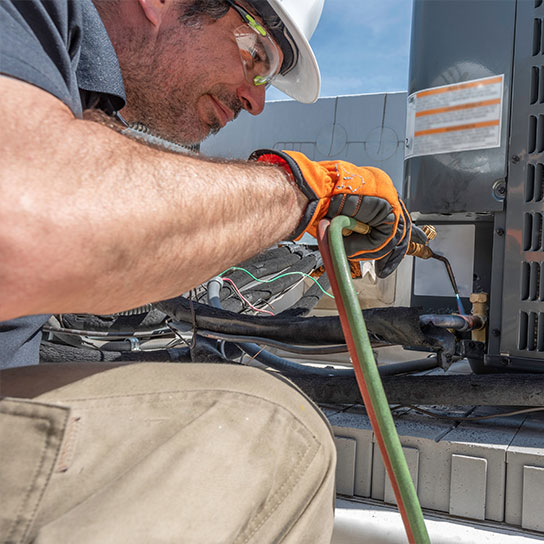
Commercial HVAC maintenance covers more ground than residential service, reflecting the greater complexity of the equipment and the operating environment. A comprehensive visit includes:
- Inspection and cleaning of evaporator and condenser coils
- Refrigerant charge verification across all units
- Electrical inspection: connections, contactors, capacitors
- Belt and bearing inspection on air handling equipment
- Condensate system inspection and treatment
- Controls and thermostat calibration
- Airflow measurement and balancing
- Filter replacement on the appropriate schedule
Beyond the checklist, we document system performance at every visit, recording temperatures, pressures, electrical draws, and airflow measurements and comparing them against prior visits. This longitudinal record reveals trends a single snapshot never would: a compressor drawing progressively more current, a coil whose efficiency is slowly degrading, a zone whose airflow has quietly dropped. Catching those trends early means addressing them on your terms.
How Often?
Quarterly at Minimum. More for High-Demand Environments.
Most commercial HVAC equipment in Houston warrants quarterly maintenance visits, with monthly filter inspections depending on occupancy density and building use. Restaurants, medical facilities, and fitness centers typically require more frequent attention given the demands their environments place on mechanical systems.
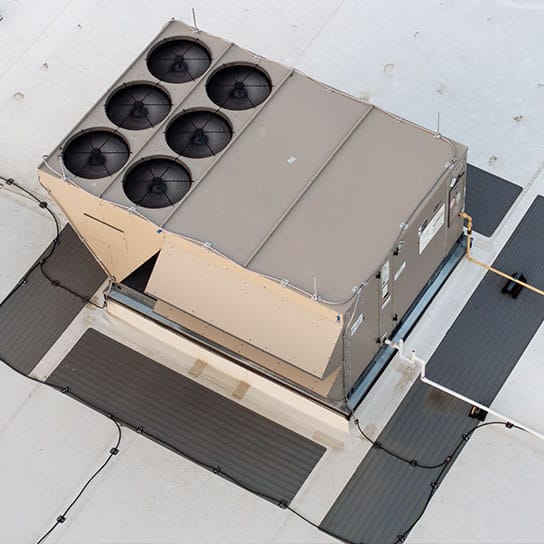
Rooftop units, the workhorse of most Houston commercial buildings, are exposed to the elements year-round. Weatherproofing, economizer components, and drainage deserve consistent inspection on every visit.
Scheduling maintenance during off-hours or low-occupancy periods minimizes disruption to your operation and allows technicians to run systems through their full range without affecting comfort in occupied spaces.
The Difference
Familiarity With Your Building Is Worth Something.
The most effective commercial maintenance relationships are ongoing partnerships. When a technician visits your building regularly, they develop familiarity with your specific equipment, its history, and its quirks. That institutional knowledge pays dividends: faster diagnosis when something goes wrong, more accurate forecasting for capital planning, and a level of system-specific insight that a first-time technician simply cannot provide.
At JW East Mechanical, we bring the same forensic discipline to scheduled maintenance that we bring to diagnostic repair, documenting, analyzing, and communicating what we find so you always have a clear picture of where your system stands and what to plan for.
Humidity Is a Building Performance Issue Too
In Houston, uncontrolled moisture in a commercial building creates problems that compound over time: mold, building material deterioration, occupant health exposure, and liability. It’s directly connected to how well your mechanical system is performing. If humidity is a concern in your building, we address that as part of the same assessment.

I’ve worked with Jim for three years now. I can always count on him to give prompt service and excellent customer service!
Pac Van
Commercial Client
Glad I called the right people. Took care of my problem right away. Very satisfied.
Eagle Plumbing
Commercial Client
common questions
What property managers ask us
How often should commercial HVAC equipment be serviced?
Most commercial HVAC equipment in Houston warrants quarterly maintenance at minimum, with more frequent filter inspections depending on how the building is used. High-demand environments such as restaurants, medical facilities, and fitness centers often need more attention. Rooftop units, the workhorse of most Houston commercial buildings, are exposed to the elements year-round and benefit from consistent inspection.
What does a commercial maintenance program include?
A comprehensive program covers inspection and cleaning of evaporator and condenser coils, refrigerant verification across units, electrical inspection, belt and bearing checks on air-handling equipment, condensate system inspection and treatment, controls and thermostat calibration, airflow measurement and balancing, and filter service on the right schedule. We also document system performance at every visit so you have a record, not just a service.
Why does documentation matter for commercial maintenance?
For a property manager or owner, the record is one of the most valuable things a maintenance program produces. We document temperatures, pressures, electrical draws, and airflow at each visit and compare them against prior visits. That longitudinal record reveals trends a single snapshot never would, a compressor slowly drawing more current, a coil gradually degrading, and it supports warranty claims, capital planning, and budgeting.
Can you schedule maintenance around our operating hours?
Yes. Scheduling preventive maintenance during off-hours or low-occupancy periods minimizes disruption and lets technicians run systems through their full range without affecting comfort for occupants [CONFIRM after-hours / weekend availability and any associated terms].
Does JW East offer commercial maintenance contracts?
[CONFIRM — this answer assumes formal contracts exist. If JW East offers commercial maintenance agreements, describe the structure: visit frequency, what is covered, response commitments, and how pricing works. If not, replace with a description of how scheduled commercial maintenance is handled on a per-visit or per-building basis.] We approach commercial maintenance as a long-term commitment to the performance of your building, bringing the same forensic discipline to scheduled maintenance that we bring to diagnostic repair.
What is the risk of skipping commercial maintenance?
Beyond the cost of an unexpected failure, deferred maintenance creates real exposure for owners and managers: uncomfortable or unusable space, tenant complaints, and in the worst case an air quality or moisture event that traces back to neglect. The cost of the maintenance visits that would have prevented it is almost always far lower than the cost of the failure.
Do you work with property managers overseeing multiple buildings?
Yes. When a technician visits your buildings regularly, they develop familiarity with each system's history and quirks, which means faster diagnosis when something goes wrong and more accurate forecasting for capital planning [CONFIRM any multi-property or portfolio arrangements JW East wants to highlight]. That institutional knowledge is genuinely valuable and is something a first-time contractor cannot provide.