
Air Quality
The Air Inside Is the Air You’re Breathing
Most people associate air pollution with what’s outside. But the EPA has found indoor air is typically two to five times more polluted than outdoor air — and in poorly ventilated buildings, VOC concentrations alone can reach 100 times outdoor levels.
In Houston, high humidity, sealed buildings, and overtaxed HVAC systems trap and amplify the problem. The air your family breathes at home, or your employees breathe at work, deserves the same scrutiny you’d give the air outside.
What’s in Your Air
Three Categories of Indoor Air Pollutants
Biological Contaminants
Mold spores, bacteria, dust mites, and pet dander thrive in humid environments and accumulate in ductwork, coil surfaces, and drain pans. In Houston, these aren’t seasonal — they’re year-round.
Chemical Pollutants
VOCs off-gas continuously from furniture, flooring, building materials, and cleaning products. Invisible, often odorless, and present in virtually every occupied space.
Particulate Matter
Fine particles from cooking, candles, and outdoor air infiltration. The smallest pass through standard filters entirely and penetrate deepest into the respiratory system.

The Symptoms
How It Shows Up
Poor air quality rarely announces itself. More often it looks like this:
- Allergies that persist indoors but ease when you leave
- Frequent headaches, fatigue, or difficulty concentrating
- Recurring respiratory infections with no clear source
- A space that feels stuffy or heavy even with the system running
- Afternoon productivity drops for no apparent reason
Children, the elderly, and anyone with asthma are most vulnerable. In commercial settings, researchers have documented the broader pattern as Sick Building Syndrome — measurably higher absenteeism and lower cognitive performance in buildings with poor ventilation.
The Root Cause
Your HVAC System Is Either Helping or Hurting
When it’s maintained properly, your system filters contaminants, controls humidity, and circulates fresh air. When it isn’t, it distributes the problem.
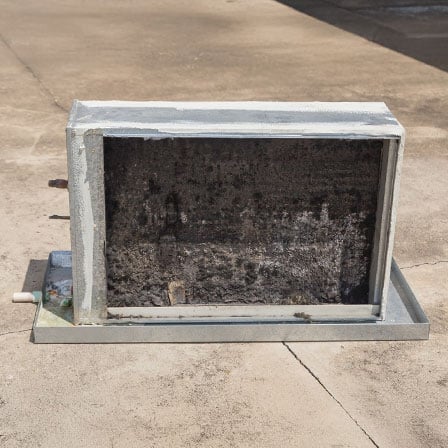
- Dirty coils harbor biological growth
- Clogged filters recirculate unfiltered air
- Drain pans that don’t clear become standing water — a direct mold source
- Duct leaks pull air from attics and ceiling cavities into your living or working space
This is why air quality assessment starts with your mechanical system, not an air purifier purchase.
Our Approach
Solutions That Match the Actual Problem
No single fix works for every situation. We assess before we recommend.
Filtration
The foundation. We match filter efficiency to your system’s capacity. The Dust Free Sixteen MERV 16 is one we install regularly — hospital-grade filtration without the airflow penalty, at a lower long-term cost than standard quarterly filter changes.
UV Germicidal Systems
UV-C lamps in the air handler prevent biological growth on the evaporator coil surface. In Houston’s humidity, one of the higher-value investments available.
Purification
Ceiling-mount purifiers and whole-home in-duct systems like the Reme Halo address contaminants that filtration alone doesn’t capture.
Ventilation
For commercial buildings, energy recovery ventilators (ERVs) bring in fresh outside air without the full energy penalty Houston’s climate would otherwise impose.
Humidity Control
Moisture and air quality are not separate problems. Controlling moisture removes the conditions biological contaminants need to establish and spread.
Not Sure Where to Start?
We’ll assess your system, identify the sources, and tell you what will actually make a difference — and what won’t.